

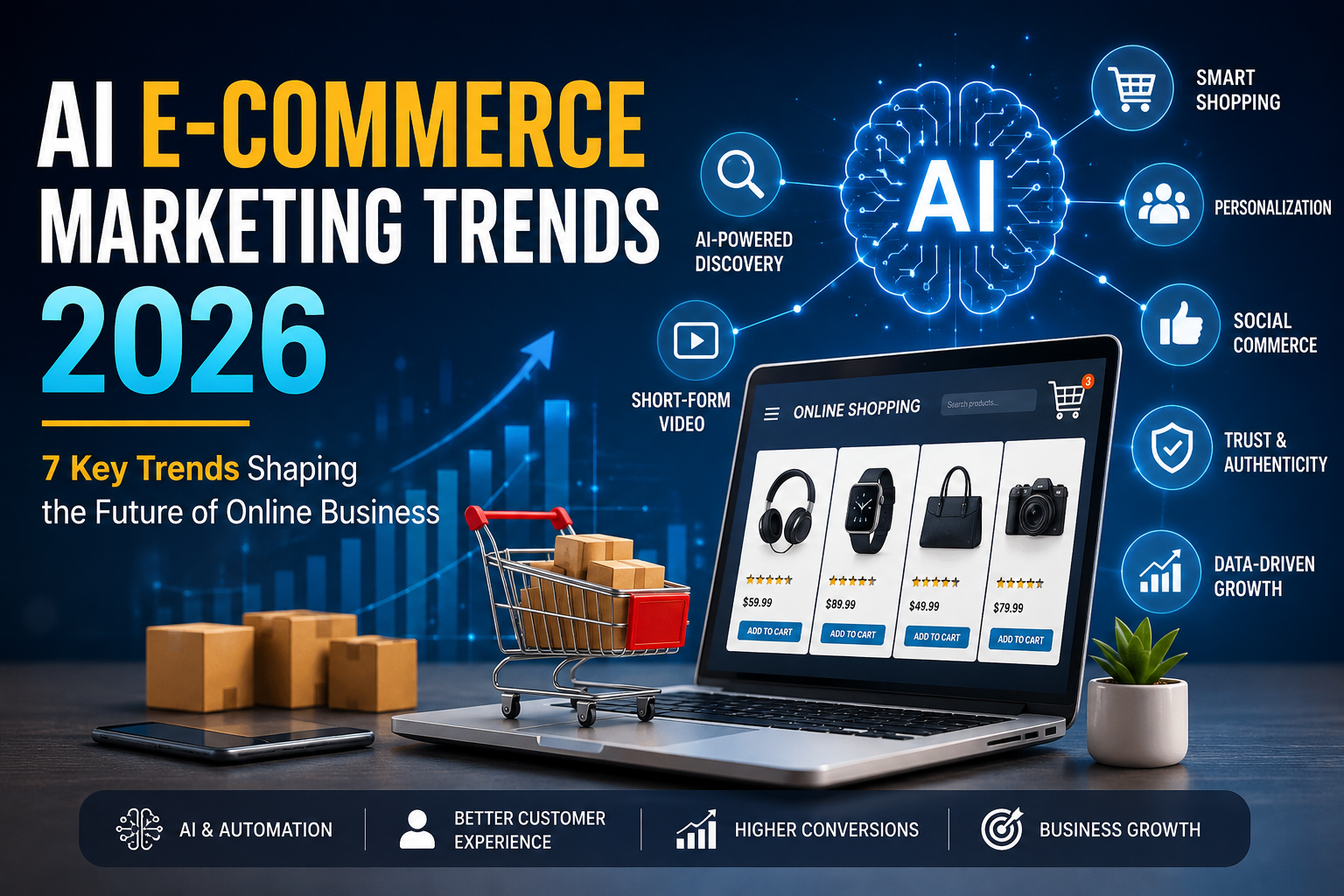
7 Key Trends
Introduction
The world of e-commerce is changing rapidly. Customers are no longer discovering products only through traditional Google searches or online stores. Today, social media, short-form videos, artificial intelligence, creator content, and AI-powered shopping tools are becoming important parts of the customer journey.
AI e-commerce marketing is changing how businesses attract customers, promote products, and increase online sales in 2026
In 2026, businesses need to think beyond traditional digital marketing. The focus is shifting toward AI-powered discovery, authentic content, personalization, social commerce, and better customer experiences.
Here are seven important trends that e-commerce businesses should understand.
Looking to improve your online presence? Explore our digital marketing services to build a stronger and more effective online strategy.
1. AI Is Becoming a New Way to Discover Products
Artificial intelligence is increasingly helping customers research products, compare options, and make purchasing decisions.
AI-powered tools can recommend products based on a customer’s questions, preferences, and requirements. Shopify’s 2026 data shows that traffic and orders coming from AI-driven sources have grown significantly, highlighting the increasing importance of AI in product discovery.
What businesses should do:
- Keep product information clear and accurate.
- Write useful product descriptions.
- Answer common customer questions.
- Include specifications, features, and benefits.
- Collect genuine customer reviews.
The goal is no longer simply to rank for keywords. Businesses should also make their content easy for AI systems to understand.
2. Short-Form Video Is Still Powerful
Short videos continue to play an important role in product discovery.
Customers can discover a product through a Reel, Short, TikTok-style video, or creator recommendation before visiting the company’s website.
For e-commerce brands, this means video should not be treated only as entertainment. It can become part of the sales journey.
A simple strategy:
Short Video → Website → Product/Blog → Purchase
Businesses can create:
- Product demonstrations
- How-to videos
- Before-and-after videos
- Customer testimonials
- Educational videos
- Behind-the-scenes content
3. Social Commerce Is Growing
Social media is becoming more than a place to promote products.
It is increasingly becoming a product discovery and shopping channel. Customers can discover products through creators, videos, reviews, and social posts and then move to a brand’s website to learn more or purchase.
For small businesses, this creates an opportunity to connect:
Instagram + YouTube + Website + E-commerce Store
Instead of treating every platform separately, businesses can build one connected customer journey.
4. Authentic Content Matters More Than Perfect Content
AI makes it easier than ever to create images, videos, captions, and marketing content.
But this also means that customers are exposed to a huge amount of similar-looking content.
In 2026, businesses need to focus on authenticity and originality. Real demonstrations, genuine reviews, useful information, and human stories can help a brand stand out.
AI can help create content faster, but businesses should still add their own experience, opinions, examples, and brand personality.
5. Personalization Is Becoming More Important
Customers don’t want to see completely irrelevant offers.
AI can help businesses understand customer behavior and provide more relevant recommendations, content, and offers.
For example:
A customer looking at kitchen storage products could receive recommendations for related organization products instead of completely unrelated items.
Personalization can improve the shopping experience when it provides genuine value to the customer.
6. Customer Reviews and Social Proof Matter
People want to know what other customers think before buying.
Reviews, testimonials, creator content, user-generated content, and product demonstrations can help build trust.
This is particularly important because customers may discover a product on social media but look for additional information and reviews before making the final decision.
Businesses should focus on:
Good Product + Good Experience + Genuine Reviews = Stronger Trust
7. Your Website Should Become Your Digital Hub
Social media platforms are excellent for reaching audiences, but businesses should not depend entirely on one platform.
Your website can become the central place connecting your:
- Products
- Blog
- Social media
- YouTube channels
- Contact information
- Customer information
- Brand story
For example:
Instagram/Reels → Website
YouTube → Website
Google Search → Website
AI Search → Website
Website → Product / Contact / YouTube
This creates a connected digital marketing ecosystem.
What Should Small Businesses Do Now?
You don’t need to adopt every new technology at once.
Start with five practical steps:
✅ Step 1
Create useful, original content on your website.
✅ Step 2
Publish short-form videos regularly.
✅ Step 3
Keep your product information accurate and detailed.
✅ Step 4
Build genuine customer reviews and social proof.
✅ Step 5
Connect your website with your social media and YouTube channels.
The businesses that succeed in 2026 won’t necessarily be the ones using the most tools. They will be the ones that use technology strategically while keeping the customer experience useful and authentic.
Conclusion
E-commerce marketing is moving toward a more connected digital experience.
AI, social commerce, short-form video, personalization, creator content, and authentic customer experiences are changing how people discover and purchase products.
For businesses, the opportunity is clear: don’t just sell a product—build a digital ecosystem around your brand.
Your website, content, social media, YouTube channels, and e-commerce store should work together to attract visitors, build trust, and turn visitors into customers.
The future of e-commerce marketing is not just about being visible. It’s about being useful, trustworthy, discoverable, and memorable.
Have questions about your digital marketing strategy? Contact E-Mart Marketing to discuss your requirements.
